

Crystal Palace manager Oliver Glasner took his FA Cup-winning side for some pre-season matches to Upper Austria. Glasner’s team certainly benefitted from the clean air and local produce, having flown home with two wins under their belt. Ramy James Salameh followed in their footsteps but explored the culture and heritage of the region from the saddle of a e-bike in a slower more considered manner.
Sitting in the world’s largest cider barrel sauna – the Mostfassl – with 50 other naked strangers might not be your traditional warm-down after a nature-filled cycle ride, but in Upper Austria this is simply how one keeps body and mind at a healthy equilibrium. It is not high-intensity workouts or Tour de France-style cycling elevations, but simply a form of slow sports travel in a rolling and beautiful landscape.
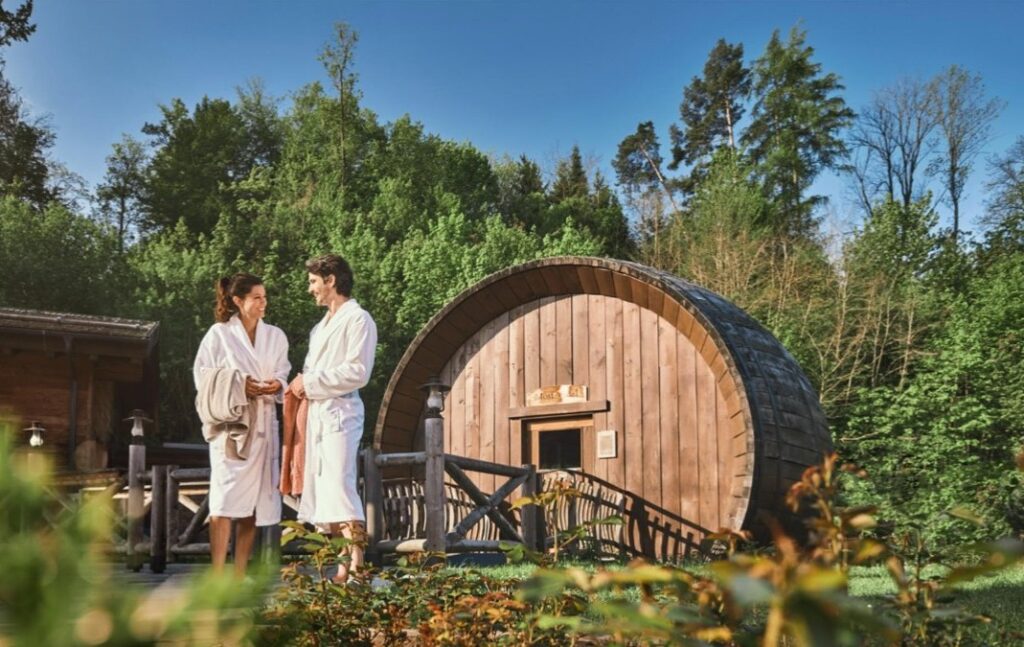
As the sauna-master ladled cider onto the hot coals and swung his towel with matador-like panache, the room filled with cider-infused steam to imbue, as sweat soon dripped from many foreheads. But fluids were quickly replaced, as trays of local cider were passed around like isotonic drinks at a hydration station, but unlike Crystal Palace’s professional athletes preparing for their upcoming Premier League season, I was in the region to move at a pace dictated by local lifestyles that are still connected with the land, the heritage and local delicacies.
Wellness here interlocks seamlessly with sports. At the EurothermenResort in Bad Schallerbach, you can recover in a Swedish-style bread-baking sauna where heat, carbs and heart-rates merge into a ritual of recovery. It’s the sort of place where one’s hectic life is left at the door and forgotten for some precious moments of rest and recouperation in various thermal baths, and heat-infused performance rituals, which lets the mind wander and muscles restore.
e-biking through the Vitalwelt
The region truly comes alive once you’re in the saddle. On an e-bike through the Vitalwelt, with mild gradients and a countryside straight out of a landscape painting, even casual cyclists feel like seasoned pros with the help of the ‘E’ in e-bike.
We were guided by the ever-enthusiastic Ernst Steger, as we pedalled up to the Magdalenaberg Church, legs warm but spirits high, encouraged by a soaring falcon above, nature’s way of motivating us to delve deeper along the cycle paths snaking into the verdant canopy beyond. Meadows thick with flowers, gentle ascents, and century-old farmsteads lined the route, which felt good for the soul and a cyclist’s slow-travel dream, all low heart rate and high satisfaction.
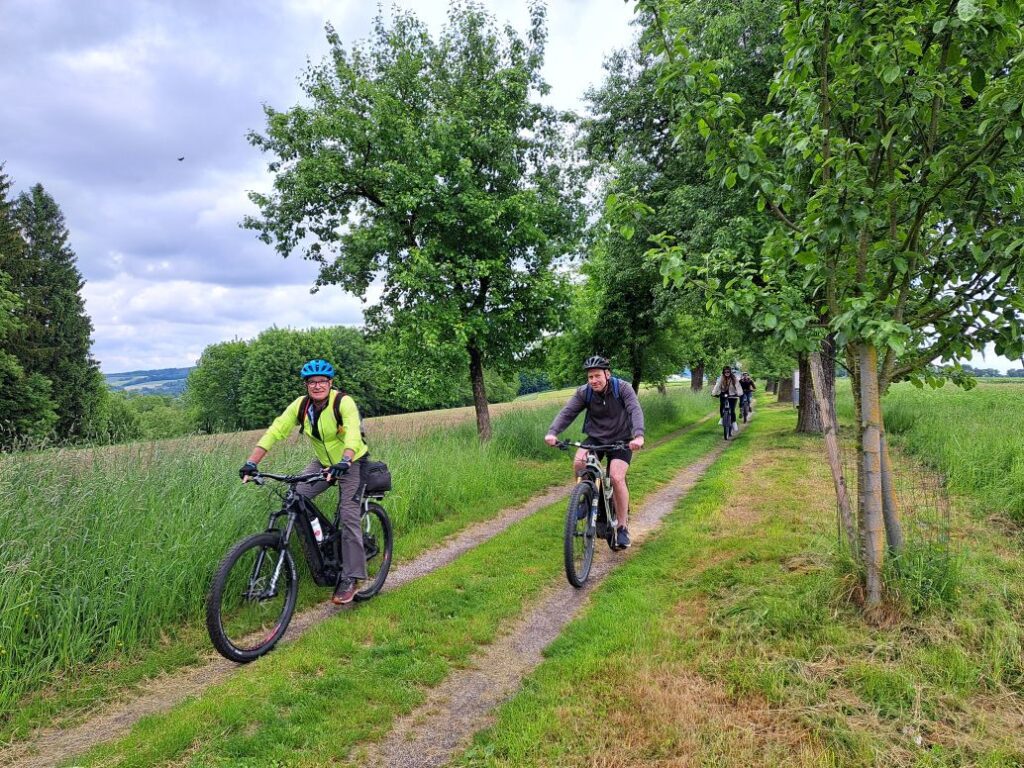
Ernst, a local teacher-turned-bike-guide, proudly pointed out his school in the town of Grieskirchen. Pedalling through his historic streets and then onto trails by the Trattnach River, we soon coasted right to his backyard patio for a home-brewed cider as his form of recovery drink, a seemingly common theme in this region. This is where the ride becomes cultural cross-training: hill climbs, heritage stops, and regional flavours replacing energy gels.
Our more substantial evening refuel was at Am Hochfeld, a hillside Heuriger serving local cold platters and “Most” cider, of course. The next day’s route took us through the St. Georgen Orchard Avenue. This is a 2.5km channel of fruit trees surrounded by flora and fauna, perfect for a shady sprint or leisurely roll. It’s technically Austria’s longest orchard lane, but but for me it felt like an ancient Roman road now enveloped by nature, but in fact was the hand of a priest from Grieskirchen who planted 450 fruit trees in a trellis, 100 years ago.
Riding beside the Danube’s Roman heritage
Onward to the Danube, where active travel pursuits met ancient Roman history, another combination which kind of framed the slow travel ethos we were after. To reach the famous Schlögen Donaublick viewpoint requires a short, steep bike hike, with calves starting to burn, the reward was a panoramic view of the iconic river bend. From here, our 30km Danube Limes Cycle Route began, and it was soon evident why it has UNESCO World Heritage listing. This easy-to-follow route hugs the Danube and is marked by a Roman centurion helmet symbol, guiding riders through archaeology and adventure.

At Schlögen, the discovery of a gold coin in 1837 led to the excavation of a Roman bathhouse, whose complete ancient structure is now viewable via augmented reality using a QR code and smartphone. Continuing in the footsteps of former Roman legions who once patrolled the banks of the Danube, we rode onto Burgus Oberranna, a UNESCO-listed Roman fortification brought to life, again, through virtual reconstructions.
Having rode passed numerous strategic Roman forts, which once marked the edges of the Roman Empire, we changed tack and cruised to the Cistercian Abbey of Engelszell, Austria’s only Trappist monastery, home to a lone monk and famed for its Trappist beers, liquors and Fritz Fröhlich’s 1950s cubist fresco adorning the ceiling of the Abbey.
From here we crossed the river by ferry, we returned upstream along narrower paths closer to nature, coming across Witti, a ninth-generation family-business of traditional boat manufacturers who can trace their family craft back to the 16th century. Using spruce or larch wood and using designs typical to the region, they masterfully build these handmade ‘Zille’ flat-bottom wooden Danube boats. With the aroma of wood-chip in our nostrils, it the final cultural twist to our immersive journey.
Linz: our urban finish line
A short train transfer delivered us to Linz, where the city’s energetic creative vibe feels like a like a fitting finish-line, but one more active-adventure awaited. This was a modest hike from the city centre to the Pöstlingberg, a 539-metre hill, which peers down upon Upper Austria’s capital.
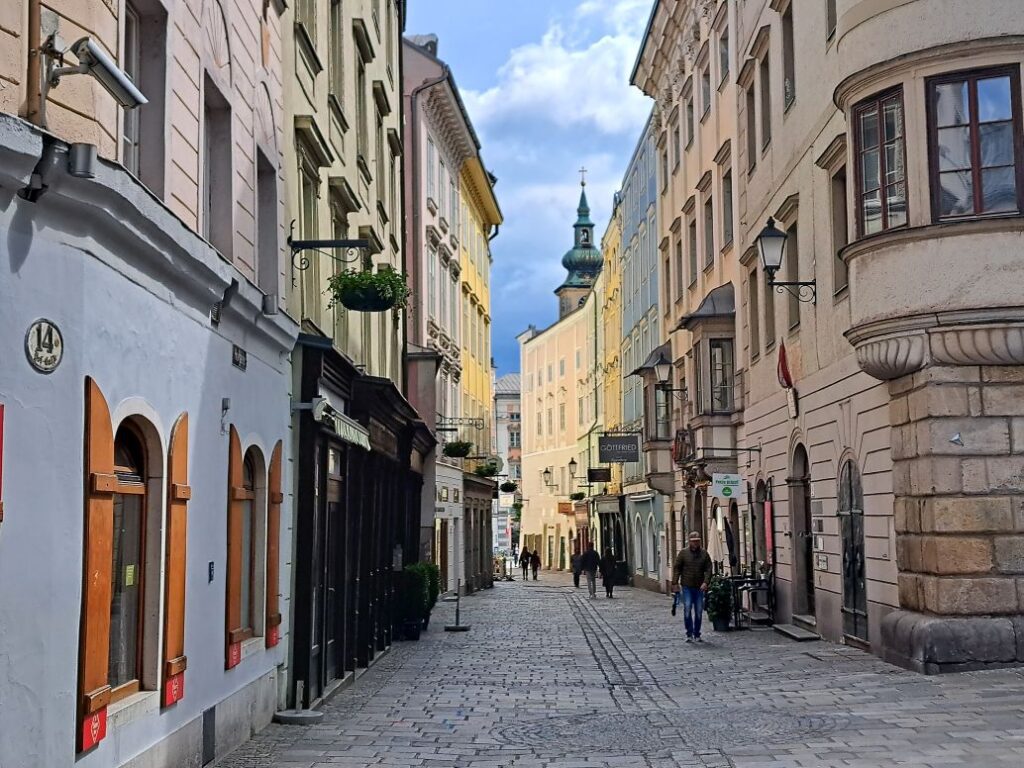
From the Trinity Column that was built in 1723 and located directly at our starting point, the old town hall, our mini-hike wound gently upward from the main square, passing Anton Bruckner University and the city zoo. At the top, we stood beside the old fort and Pilgrimage Basilica, looking across the cityscape of Linz.
From here, Linz’s layered history unfolded before our group; the site of an ancient Roman fort, the compact Altstadt (old town), and the vast steel plant built under Hitler in 1938, which later made the city a major WWII target were all pointed out and explained by our city guide. Linz is also recognised as an UNESCO City of Media Art; the modernist cultural landmarks of the Ars Electronica Centre and Lentos Kunstmuseum, were easily visible by day but even more so by night when they pulsate with LED lights across their glass and steel façades.
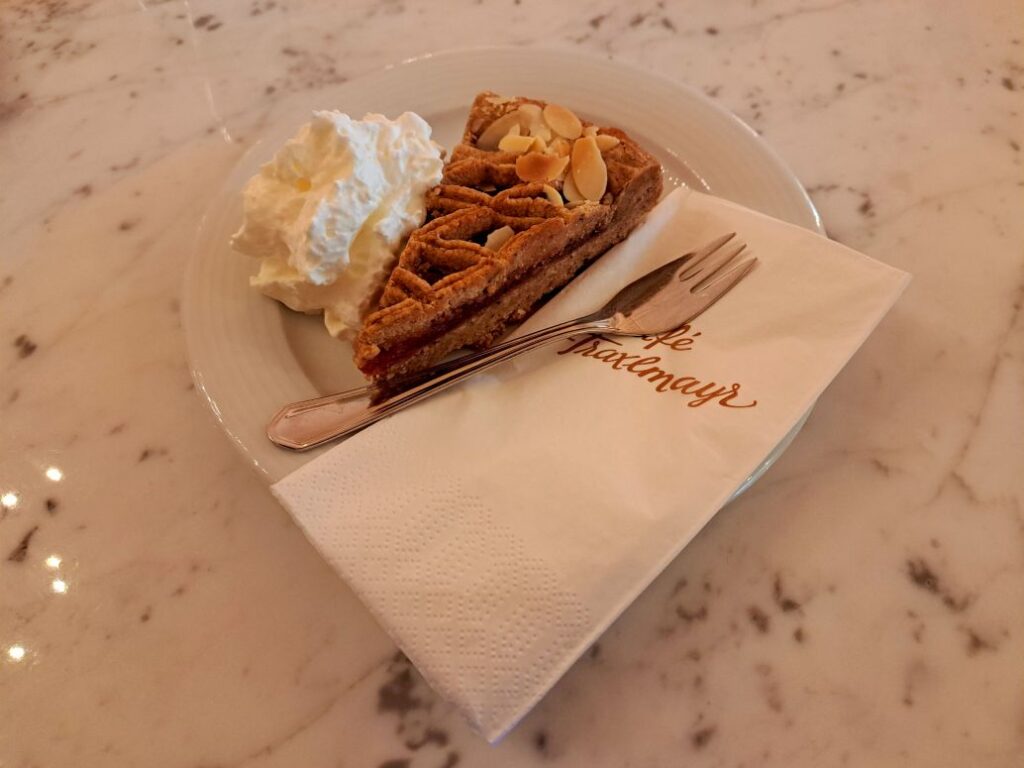
Descending into Linz’s historic alleys and riverside cafés offered the perfect cool-down. At Café Traxlmayr, we re-fuelled with Linzer Torte, famously delicious and the final calorie-filled reward, before planning tomorrow’s route towards another slow travel escape.
For more information see vitalwelt.at, eurothermen.at and linztourismus.at