
Seine-Saint-Denis was the beating heart of Paris 2024 and a major reason why the French capital has been ranked the world’s top sports city in 2025. Ramy James Salameh discovered the reinvention of the northern Parisian suburbs accelerated by the Olympics.
Let me set the scene. I was swimming in France’s highest pool, some 140 metres above the ground beneath a neon sign declaring ‘head in the clouds’ and beside floor-to-ceiling windows looking out upon the gleaming venues of the Paris 2024 Summer Olympics.
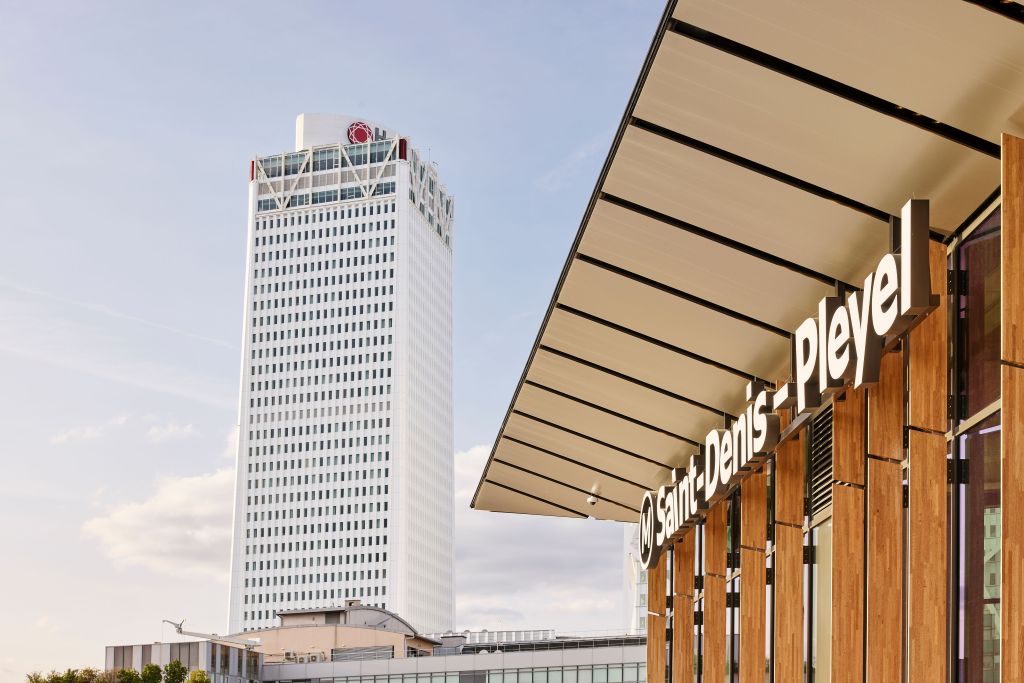
I’d checked into the H4 Hotel Wyndham Paris Pleyel Resort in Seine-Saint-Denis a part of northern Paris which encompasses a collection of suburbs beyond the Périphérique, now boosted by the Olympics and evolving into a symbol of creative energy, cultural renewal and sporting legacy.

The hotel opened on the eve of the Games, this 697-room skyscraper is now an anchor of the area’s urban revival, complete with Paris’ largest privately owned convention and meeting centre wrapped around its base.
From my 40th-floor perch, the Stade de France was easy to spot. Built for the 1998 World Cup and now the scene of Armand Duplantis’ record-breaking pole vault and Olympic gold. Beside it stands the new Paris Aquatics Centre, where Léon Marchand claimed quadruple golds. Marchand and the French Swimming Federation even stayed at the H4 during the Games, adding some Olympic trivia to my stay.
The hotel’s location is a dream for sports fans. It’s within walking distance of the main venues and the former Olympic Village, and just steps from Saint-Denis Pleyel Metro Station, a key hub linking central Paris in under 15 minutes via the automated Line 14, and Orly Airport in around 40. New Grand Paris Express lines (15, 16 and 17) will open in the future, transforming Pleyel into a strategic terminus, connected to the Stade de France RER station by an elegant Olympic walkway bridge.
The H4 is already courting sports lovers with its new ‘Stade de France Package’, including a room upgrade, late check-out and a packed lunch ‘to go’. Most rooms feature sweeping views and a chic mix of comfort and industrial style, softened by parquet floors and modern art. Fittingly, the hotel sits on the site of the former Pleyel Piano Factory, once patronised by Chopin and Debussy.

Sharing the 40th floor with that spectacular pool is ‘The Stage’, the hotel’s Sky Bar, where cocktails come with an unforgettable panorama of the capital, where guests see the Eiffel Tower twinkling, Sacré-Coeur perched on Montmartre, even Notre-Dame in the distance. It’s the perfect spot to toast the day, especially after a session in the 38th-floor gym.
Yet Saint-Denis deserves exploration beyond the pool deck. The Aquatics Centre impresses architecturally, with an eco-responsible design highlighted by a concave, solar-panelled roof and seats made of recycled plastic. Visitors can swim in the Olympic-standard pool, scale an 800sqm climbing wall, play padel or snap selfies atop the original medal podium used in the Games.

Nearby, the Cité du Cinéma, inaugurated by filmmaker Luc Besson in 2012, occupies a vast 1930s thermal power plant which was used as the Athletes canteen during Paris 2024. Soon it will evolve into a 60,000-square-metre cultural and events hub; it’s Paris’ answer to London’s Battersea Power Station both in scale and architectural drama.
Other neighbourhood gems include the Académie Fratellini, dedicated to contemporary circus arts, and the PANAME Brewing Company, where street art frames an industrial-chic courtyard and the craft beer being produced can only be tasted in the French capital.
A short stroll away in Saint-Ouen stands the new Adidas Arena Porte de la Chapelle, an 8,000-seat venue hosting basketball, concerts and cultural events. The area’s creative, slightly edgy vibe extends to the legendary Marché aux Puces de Saint-Ouen, one of the world’s largest flea markets. Its 12 covered halls and 2,000 vendors are a treasure trove of antiques and Parisian stories. Make sure to take a guide along for browsing, you’ll discover where Édith Piaf once sang and where Midnight in Paris and Lupin were filmed.
Saint-Ouen is also home to Red Star, Paris’ oldest football club, founded 121 years ago by Jules Rimet, the man behind the original World Cup trophy. If one sporting entity typifies Seine-Saint-Denis then it is this club, one of the founder members of Ligue 1, but staunchly committed to the community it serves.
Equally unmissable is the Basilica of Saint-Denis, the first masterpiece of Gothic architecture and the burial place of French royalty. Its luminous stained glass and 70 sculpted tombs trace the evolution of both art and monarchy. Even this ancient landmark is being renewed, its missing northern spire is to be rebuilt by artisans who worked on Notre-Dame, their craftsmanship showcased in an Artisan Village located at the feet of the basilica, will soon be opening to the public.

The roar of ‘Allez Les Bleus!’ still echoes across Seine-Saint-Denis, as Paris was ranked the world’s top sports city for the third consecutive year in 2025, and this vibrant district surely played a starring role. For fans chasing sporting history, Olympic legacy and local culture, the experience beyond the périphérique has never been brighter.
Image credits: H4 Hotel Wyndham Paris Pleyel Resort & Ramy James Salameh